 By Techy Journal
You may have seen the term “1.5f8‑p1uzt” floating around in 3D‑asset libraries, texture repositories, or developer forums, usually tagged alongside textures, assets, or shader presets. But what exactly is 1.5f8‑p1uzt? Is it a cutting‑edge texture format? A unique identifier for versions and presets? Or just marketing hype?
What is 1.5f8‑p1uzt
According to various online sources, 1.5f8‑p1uzt is described as a next‑generation texture or asset format that aims to combine high visual fidelity with efficient performance. The logic behind the name:
- The “1.5” is often interpreted as a version or revision number.
- The “f8” suggests floating‑point (or “float8”) precision per channel, a step up from standard 8‑bit integer textures.
- The “p1uzt” suffix is often described as a unique identifier, variant tag, or preset label that distinguishes a particular texture profile or asset variant.
Based on these claims, 1.5f8‑p1uzt is pitched as much more than a simple image: a “multi‑map container,” a unified file that can hold diffuse, normal, specular, height/displacement, and possibly more advanced data like micro‑geometry or spectral/light‑response information.
Advocates say this format can dramatically simplify asset pipelines: by reducing dozens of separate map files to a single file, by enabling adaptive compression and real-time rendering, and by offering cross‑platform compatibility across popular engines and tools.
What We Know: Evidence & Verifiable Facts
While these descriptions are intriguing, it’s important to stress: there is no widely accepted, authoritative documentation for 1.5f8‑p1uzt as an official standard. Multiple data sources describe the format, but none point to a specification maintained by a standards body, a recognized graphics‑engine manufacturer, or an academic publication.
In fact, some analyses suggest that 1.5f8‑p1uzt may be more of a proprietary or internal label, perhaps used in closed‑source tools or private asset libraries, not meant for broad public adoption.
This lack of formal recognition means that:
- There is no guarantee that standard engines (or future engine updates) will support it.
- Public repos, documentation, or community forums seldom reference real usage of 1.5f8‑p1uzt.
- What you see on various blogs may reflect marketing claims rather than proven, production‑ready reality.
In short: what we know for sure is that 1.5f8‑p1uzt exists as a claimed format/identifier, but we don’t have independent verification that it’s broadly supported, or that it behaves as advertised under all conditions.
What We Don’t Know / What’s Risky
Because of the lack of authoritative documentation or widespread adoption, several risks and uncertainties come with using 1.5f8‑p1uzt:
- Compatibility Issues: If engines or tools don’t officially support it, textures might fail to load or render incorrectly.
- Maintenance Risk: Since there is no community-wide standard, long‑term support is uncertain. Future engine updates could break support.
- Quality Inconsistency: Claims about high‑fidelity 16‑bit, multi‑map, or spectral data may not hold in all implementations, especially if “p1uzt” variants are proprietary or experimental.
- Unknown Licensing or Rights: Some writeups speculate that 1.5f8‑p1uzt may originate from proprietary or even AI‑generated assets subject to copyright concerns.
How to “Use” 1.5f8‑p1uzt
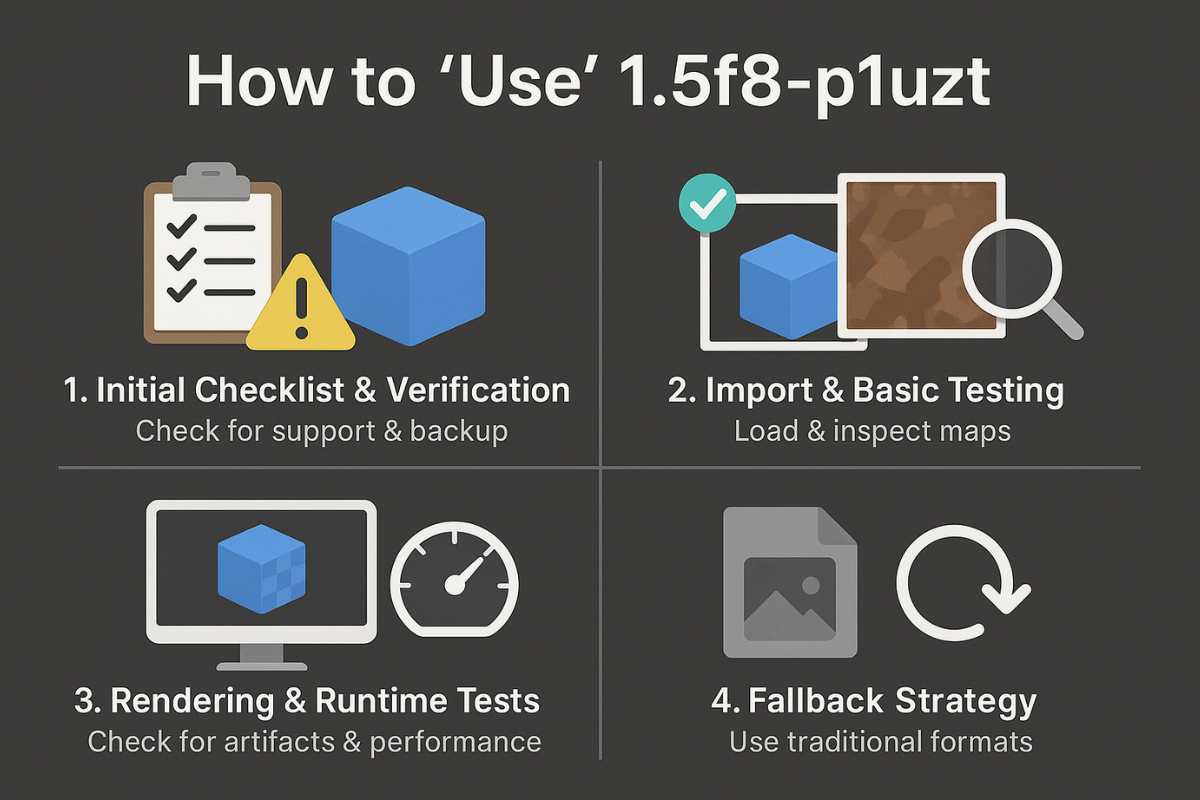
If you’re curious and want to experiment with 1.5f8‑p1uzt, here’s a cautious workflow you can follow:
1. Initial Checklist & Verification
Check whether your engine or 3D tool offers any documented support for 1.5f8‑p1uzt (or custom texture formats). Before you import or replace any textures, keep a backup to avoid corruption or irreversibility. Don’t apply textures to critical or final assets. Test on dummy models first to spot rendering issues early.
2. Import & Basic Testing
Load the texture. Inspect whether diffuse, normal, specular, and displacement (if supported) maps appear correctly. Compare visually and in terms of performance (FPS, memory usage, loading times). Try on different hardware (high-end GPU, mid-range, mobile/mobile‑equivalent) to measure compatibility and performance.
3. Rendering & Runtime Tests
Test in both editor and runtime (game mode, preview mode, rendering pipeline). Check for artifacts, visual glitches, performance hits, or crashes. If your project uses LoD systems, real-time lighting, and post-processing, ensure that texture behaves correctly under all conditions.
4. Fallback Strategy
If anything fails, have a fallback plan. Use traditional texture formats (e.g., PNG, DDS, KTX) or more established modern formats. Don’t commit to 1.5f8‑p1uzt until you’re satisfied with stability.
Read More: Falotani: Myth or Reality?
Alternatives: More Reliable / Established Formats or Methods
Given the uncertainties surrounding 1.5f8‑p1uzt, it’s wise to consider well‑supported, standardized texture formats. These include:
- PNG/TGA/DDS are widely supported, stable, and predictable.
- KTX / KTX2 / Basis Universal modern, compressed formats with broad engine and platform support.
- Engine‑native compressed texture formats (e.g. Unity’s or Unreal’s platform‑optimized formats) optimized for memory, performance, and compatibility.
Compared to 1.5f8‑p1uzt’s speculative promises, these alternatives offer certainty and community support. They may lack some of the theoretical “material genome” ambitions, but they deliver reliability.
FAQs
What exactly is 1.5f8‑p1uzt?
1.5f8‑p1uzt is described as a specialized texture/asset format or identifier. The “1.5” often refers to a version, “f8” to floating‑point precision per channel, and “p1uzt” to a unique variant or preset label. It’s claimed to combine multiple texture maps (diffuse, normal, specular, height, etc.) into a single file.
Is 1.5f8‑p1uzt a standard / verified format?
No, there is currently no widely accepted public standard or official documentation confirming 1.5f8‑p1uzt as a universally supported format.
Can I safely use 1.5f8‑p1uzt in my 3D project?
You can experiment with it, but only as a test or in non-critical projects.
What are the risks of using 1.5f8‑p1uzt textures?
Risk factors include lack of engine support, unpredictable rendering behavior, lack of community adoption or documentation, potential licensing or proprietary concerns, and difficulty maintaining long-term compatibility or asset pipelines.
Conclusion
1.5f8‑p1uzt is an intriguing concept: a texture/asset format that promises high fidelity, multi‑map consolidation, small file size, and cross-engine compatibility. Many sources describe it as a “next‑generation” format, ideal for games, VR, film, and design. If you approach it with caution, due diligence, and thorough testing, 1.5f8‑p1uzt might offer interesting possibilities — but don’t adopt it blindly.